Wednesday, July 10, 2013

Training Strategies For A Marathon: GCAM 2013 (Part 2)


2) Very Light
I am not a proponent of weight-loss for sporting performance. I have an ecto-mesomorphic build, and a high metabolism to support it. Endurance sports merely stoke my basal calorie-consumption (rest) and active calorie expenditure. I have to eat a huge amount of carbohydrates (simple and complex) to maintain my race-weight of 77kg. In recent months, due to my preparation for Kona I have a training week comprising 12-18 hours. As these are mainly aerobic sessions, spread over three disciplines (swim, ride, and run), my bodyweight and bodyfat has fallen appreciably. I have a smaller waistline and defined abdominal muscles. Although this may be aesthetically pleasing, a impending danger for me is being too ‘skinny’.

I found out in 2009 at the Ironman 70.3 World Championships in Clearwater, Florida, that when I lost 2.5kg (and had 7.7 percent bodyfat) my cycling power plunged. I had my worst performance compared to the championships on 2008, where I earned my PB. I am cautious about losing too much weight, for I will need both muscular strength and power (and therefore, muscular mass) to ride better in the cruel Kona headwinds and side-winds.

AVOID DIETING OR DELIBERATE WEIGHT LOSS IF YOU ARE RUN FASTER.

Let your body decide. If you feel fatigued, and your recovery is slow – enhance your nutrient (and caloric) intake. Fuel your body before, during and after the race.

Nutrition-wise, I used the following nutritional assistance:

a)    Deep-sea fish oils (Omega-3 fatty acids): 2-3 capsules (1,500mg each) daily. Load up on this as it is an alternative to glucosamine, and it helps lubricate our joints and strengthen our cells.
b)    Virgin coconut oil: The secret weapon of CrossFit/WOD athletes. I take 2-4 teaspoons daily. One of the man effects of coconut oil is that it stokes your metabolism, and is a valuable source of essential fats (even though it is saturated – thus, it is very stable even when cooked). I drizzle it over my salad or chase it with a whey-protein drink or mix it in my coffee (Super-Coffee). Thanks Karolina for this valuable serving tip!
c)    Organic, tart cherry juice (half-mug) for significant reduction of muscle soreness.
d)    Pomegranate (organic) juice: For added antioxidants (one of the highest fruit sources) to neutralize the aging effects of endurance sports.
e)    Whey protein. Next best source next to a steak (beef). I use Muscle Milk (from Cyberhealth Pte Ltd), once or twice a day. I either supplement my breakfast, or use it before sleep to stimulate Growth Hormone (GH) release.
f)      My overall fat intake has increased. I take more butter and olive oil, but avoid margarine and related products.
g)    I spend more time in the sun to enhance my vitamin D production, and ward off depression. Cholesterol is a precursor to vitamin D, so my higher cholesterol intake is justified.

Let us be serious about nutrition. Endurance sports is damaging to our body on many levels. It ages us. It depletes key nutrients, which is hard to track until symptoms reveal themselves. Consider it this way, when you feel sore after each run session your body is undergoing major changes and it requires repair and replenishment.

3)    Very Strong Core

I supplement my triathlon training with short, strength sessions. I apply the principles of CrossFit training focused on a circuit of 5-6 exercises done with my bodyweight and external weights (Kettle-bell). I ensure that I work the major muscle groups (especially the opposing muscles). Muscles work in pairs: agonists versus antagonists – push and pull.

My core workout may look like this:

Balance-Disc (10 minutes)
Push-Up (15-20 reps) followed with one-arm, kettle-bell Rowing (12-15)
Shoulder-Press (kettle-bell) followed by Upright Rows (12-15 reps each)
Parallel Squats (15-20 reps)
Plank (60 seconds)
REPEAT CIRCUIT TWO MORE TIMES.

I don’t normally stretch, however I do ensure a proper warm-up.

MUSCLE BALANCE OUTWEIGHS STRETCHING EFFORTS.

I use the Balance-Disc to build my proprioceptive balance. I believed that balancing activates deeper, underlying muscles required for running. Balancing on the disc challenges your lateral muscles (sides), your lesser used muscles of your legs (adductors and abductors) which are needed for dodging runners in the early stages of the race. To challenge your core further, you can add light weights, or close your eyes.

FOCUS ON A PROPER WARM UP, NOT STRETCHING, FOR RACING OR TRAINING.

If you must stretch, do it after an aerobic/anaerobic session. Muscles are more pliable after your core body temperature has risen.

Although brief and simplified, I hope that this piece has been useful. Write me if you have questions. May you achieve your running PB soon!

Training Strategies For A Marathon: GCAM 2013 (Part 1)


I like to share my tips on how I achieved my recent personal bests time for my marathon. On 7 July, I earned a PB and BQ at the Gold Coast Airport Marathon. In addition, I enjoyed good splits for my 10km, 21km, and 32km marks.

In summary, if you aim to excel in your run times you will need to be:
1)    Very fit (aerobic base/cross-trained).
2)    Very light (run racing weight).
3)    Very strong (core).

The first two goals are the crux of success of the top Tour De France riders (minus the ‘edge’ they gain from pharmaceutical assistance). The third factor is required to maintain good form (gait) throughout the race, especially when you want need to ‘dig deep’ or push through fatigue.

1) Very Fit

Since I suffered an expensive hairline-fractured toe (metatarsal) last August (confirmed during Ironman Zurich), I have built my aerobic base – gradually – with low-heart-rate cycling and running. During my two months of active rehabilitation, I rode indoors and swam regularly. In spite of ZERO RUNNING (except for two short runs during race week), I finished in 4:00 Berlin Marathon – one of my worst finishes, yet it was encouraging for my aerobic base supported my comfortable completion.

RACING SPEED IS BOLSTERED AND BOOSTED BY A STRONG AEROBIC BASE.

Since August last year, I have focused on building my aerobic base. Based on Phil Maffetone’s philosophy, I ensured that my heart rate did not exceed 133-138 (180 minus Age + 5bpm for no sickness in entire year). It was cruelly slow and I had to walk sometimes (as my heart rate threatened to climb). However, I was allowed up to two anaerobic sessions per week. A race constituted an anaerobic session, which meant racing above my aerobic threshold (138bpm).

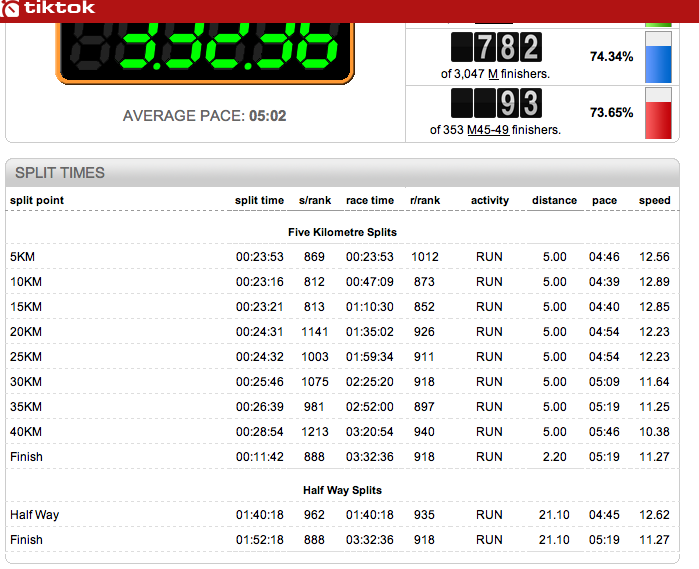
My halfway splits in GCAM 2013 for the 21km was 1:34:47, almost equal to my performance at the Sundown Marathon in late-May. How I managed to achieve this similar timing was probably due to my dedication to tempo runs on my 10km and 21km sessions. I kept to my pace of 4:25-4:35 minutes per kilometer. In fact, I extended my pace further than 21km hoping to sit on a ‘second and third wind’ (fat oxidation stage). However, I over-arched myself and could not sustain my pace and faded into 4:45-5:15 min/km pace range after the 30km mark. I was tempted to test my limits (as a 3:08-3:10 finish was within my reach), so I braved an ‘All or Nothing’ call. I paid for it in the back-end and missed a negative split by a mile (literally in minutes equivalent).

Analysis: I did not get to do my long run of 28km at 5:05-5:10 pace due to the haze/smog. So, that bit of tapering was forgone and forgotten. I continued with my taper of two 21km runs (within three days) and a few 10km sessions as part of my taper.

My approach to running is contrarian: LESS IS MORE. Caveat: This may apply only to the older athletes. Because I train over three disciplines – swim, ride and run – I can afford to run less as I activate my aerobic fitness constantly. Plus, I believe that the ‘cross-over’ effect of the swimming and riding rolls over into my running fitness.

I REST ONE OR TWO DAY/S EVERY WEEK.

Rest is crucial to full recovery and recuperation. I cannot over-emphasise its importance. My training schedule, done alone, is:

1-2 sessions of 21km runs (long runs, at tempo/fartlek pace).
2-3 sessions of 10km (shorter runs, at tempo/fartlek pace).
*Maximum run of 28-32km (once a week, 4-6 weeks out from race-day)
No hill-work (okay, one bridge).
No interval sessions.
All workouts are performed at tempo (fast/moderate).
Base, aerobic, training is the slowest (done 6-9 months out).
Caveat: I may be faster IF I incorporate a systemic run program, with track intervals and hill-work.

Instead, I use Fartlek (‘Speed-play’) that is an intuitive, variable-paced, approach to running. I observe that clever racing is a combination of various paces and patience. You can run intuitively as you can logically. The various interplay of speeds, pauses and alertness/awareness determine your performance. If you are not aware of your fatigue levels or monitoring your watch/heart-rate, it can spell disastrous results.

TRAINING = WORK + REST

My mileage for GCAM was only 40-45km per week. It falls far below the 70-90km serious marathoners usually do. Most of my sessions are aerobic (lower heart-rate). I include only two anaerobic sessions per week. I subscribe to the training philosophy of Dr Phil Maffetone and Ironman legend Mark Allen. My increased use of essential fats was also attributed to the Maffetone, as I was focused on building a strong aerobic base for Ironman triathlons (where it ends with a marathon after 3.8km of swimming, and 180km of cycling). I would recommend a base training of 60-120 minutes per session at aerobic zone (180-AGE = maximum, and avoid exceeding it). Do this for at least 4-6 months. You will feel you are too slow, but you will become faster once your HR falls and you increase your pace. I believe that mileage is not the key, as is training in your aerobic zone/fat-burning zone.

Too much mileage can lead to one road: injury. Common maladies of over-distance and intense speed-work are plantar fasciitis, heel-spurs, archiles strain and possible stress fractures. I did not want to risk that.

RACES ARE CONSIDERED ANAEROBIC SESSIONS.

I have discovered over my last few A-races (Ironman New Zealand 2013) and Sundown Marathon (21km) that my aerobic base allowed me to operate in new territory of sustained anaerobic pace (4:30 min/km). My training tempo pace have been about 5:15-4:45 min/km, which is unusual.

With my recent results, although the training is specifically geared towards the Ironman World Championships in Kona-Hawaii in October, I am pleased. I hope to meet my dream-mark of a sub-4:00 hour marathon during an Ironman race. With a differential of about 30-40 minutes for a stand-alone and Ironman marathon, I am well within the hypothetical measure. Fingers crossed.

Monday, July 8, 2013

Gold Coast Marathon 2013: A Personal Best & Boston!

I finally did it. My plans fell into place with a clarity of vision, erasing years of disappointment and near-misses.

I earned a personal best (PB) for my marathon by 13 minutes, am eight minutes within my Boston Qualifying (BQ) time, and improved on the course by 16 minutes (in 2011). I almost earned a half-marathon personal record, however deliberately held back. With any more luck, I will be Boston-bound next year in April. In 2011, I qualified by a margin of one minute (3:29:59).
My 2011 results and placing. I cramped at the 36km mark because of over-heating.
It has been a hard few weeks of preparation, with primary focus on doing well for Kona on 12 October; but with my eyes on my dream of doing Boston Marathon once.
Circa, 7 July 2013, I earned a PB but did not get a negative split, and inadequate training accounted for my 'bonk' at the 30km mark. 
I am hobbling along today, with a severe case of Delayed Onset Muscle Soreness (DOMS), but it has been all worth it. I have been cycling indoors a fair bit, sometimes twice a day (what with the terrible haze/smog) we experienced region-wide. The swim sessions and core-strengthening workouts helped heaps, I believe. I was in unfamiliar territory, holding 4:20-4:29 minutes/kilometre pace. At one point, I thought I was on-track for a 3:08-3:09 finish, but that soon evaporated as my body surrendered to my physiology. I wore a black, two-piece, tri-suit with FUEL-BELT, CrampFix electrolytes, Hammer Nutrition (Perpeteum mixture), Road-ID, Garmin 310XT watch, and ON running shoes. I kept things simple, so I could focus on my 42.195km plan. 

I hope and believe that I can earn a sub-3:10 marathon by year's end. I will, therefore, refocus after the Ironman World Championships.
Time to recover before I resume training for Cebu Ironman 70.3, and Kona. More details of my Gold Coast Marathon training shortly. Thank you supporters and sponsors for your continued encouragement!

Saturday, July 6, 2013

Pre-Race Rituals: Gold Coast Airport Marathon 2013

Day 3: In the hotel lobby. Surfer's Paradise is the place to be, with the vast ocean, incessant white-water, waves, eagerly pushing towards the flat shores.  The race fair looks the same as 2011, with the major players intact. I got my race-bib (and an empty sling-bag) yesterday at the race-expo. I am tagged and ready-to-go.
My race-kit has been laid out, albeit in a cluster. My race-kit will be a two-piece tri-suit, race-belt/bib, Ryder sunnies, Fuel-Belt, Perpetuem (Hammer Nutrition) gel, CrampStop salt tablets, ON running-shoes and RoadID wristband. My BBQ awaits me: Brisbane Boston Qualifier (3:24 or less).
I ran 10km yesterday at about 6.15pm and it was almost dark. After dodging traffic and running into cul-de-sacs, I managed a moderate 51 minutes ending at the weekend flea-market. I sensed that I am responding very well to the beautifully-clean, cool and salted air. I will be doing a short workout soon; my pre-race ritual. I intend to do a 30-minute stationary-bike ride, and 20 minutes swim. I feel inadequate without doing any endurance training over the weekend. Kona beckons me in about 13 weeks' time; a few A-races frame my passage to my dream race in Hawaii. Of course, the holy grail of Boston Marathon is my goal in April.

Have a great race, all marathoners and runners. Big shout out to Team Singapore - Have a brilliant race on a fabulous, flat course, with huge support from volunteers!

Tuesday, July 2, 2013

My New Sponsors

In the past week, I have been fortunate to be in pleasant discussions with sponsors for my upcoming races, including my participation in the Ironman World Championships in Hawaii on 12 October.

One of my sponsors will attend to my running needs with training and racing shoes; certainly I will be exclusive in my commitment to their brand/designs. The other sponsor will offer me music devices to train and be motivated with. I am excited about the latter as a three-time Ironman world champion is currently representing them. I am honoured to belong to a privileged position. So far, my initial discussions have yielded positive intentions and a flexibility of approach. I attribute this to my fervent supporters in the multi-sport endurance community, professional athletes, other sponsored athletes, and friends. I am so fortunate and surprised by this generous gesture of optimism, faith and collaboration.

I admit I have been passive about sponsorships. After all, I have self-funded all 15 of my previous Ironman triathlons all over Europe, Asia-Pacific, and the USA. Some of my more successful compatriots have earned major sponsorships through their competitive achievements. They have pledge their case, backed it by their strong and consistent performance, so they deserve their sponsorship and sponsors.

Certainly, the sponsored athlete has to make certain reciprocations with their time. They may make public or private appearances, share their experiences with fans and the sporting community, and perform well in key races. Otherwise, the least they can do is represent themselves well as leaders and ambassadors of the sport/brand, and 'sneeze' their opinions and recommendations to the universe of social media. They rouse the tribes, hopefully, into supporting a sponsored event by participating, supporting a charity, or making a purchase of the sponsors' product line. Sponsorship is about initiating the Law of Reciprocity, and Social Evidence. It is about engagements and conversations with the Tribes.

I will update more as I inked the deal, and tattoo their brands on my 'presence'.

Monday, July 1, 2013

Successful Brands

What makes a brand successful? 

Many factors may account from this, including brand loyalty, annual sales, sustained sales, repeat sales, positive brand associations, tribes (promoting their cause on social media), and brand extension. Merchandising is an extension and expansion of positive brand reputation. Wearing attire with the brand/logo is a testament to brand loyalty and strength.

In some cases, emerging brands earn cult status, and can be painted not only on merchandise but also on one's person. Tattoos are a permanent statement of brand faith and appreciation. How logos are tattooed on one's body as a badge of honour, or as bragging rights? There are, interestingly, only a few. Harley-Davidson and M-Dot (Ironman) are two that can be seen on the skins of adventurous athletes.

The M-Dot logo has been imprinted on the skins of many finishers of the Ironman World Championships in Hawaii. I have seen mini-versions as well as scaled-up versions in blood-red ink. Some unique ones include a circumference of flags to commemorate countries where the finisher has completed the 226km triathlon. Such is the strength and cult status of a fairly young brand (born in 1978), where finishing such a challenge is life-altering and mindset-shifting. The M-Dot events attracts up to 2,000 participants per race, and the lottery for 200 slots (for non-prodium qualifiers) is a yearly subscription.

Do you know of established brands that end up on a large body of followers' bodies?

Thursday, June 27, 2013

Pre-GCAM 2013

It is about a week from the Gold Coast Airport Marathon 2013. On 7 July, I will join thousands of marathoners (running-mates), and dozens of Singaporeans to take on the cool and flat course on Surfer's Paradise.

The week-long haze assault has done its nefarious damage, distressing runners with this 'wrench in the cogs'. It has affected tapering plans, however, runners being who they uniquely are will find a way through the obstacles. I decided to train indoors, focused on riding on trainer and core strength development. With windows shut, and air-conditioning and ioniser on, I paid my dues. My longest ride was 3 hours and shortest about 75 minutes, however I made time for up to two such sessions a day. I completed the workout with a CrossFit-type session with basic exercises with my bodyweight, kettle-bell and balance-board. Already, I feel my core muscles are stronger and running gait more confident and activated.

With a mild improvement of the ambient air, I have run almost everyday (since Monday) with short 10km bursts. My first run after a week was a promising sub-50 minutes for the 10km. Other than mild puffing (I suspect the micro-particle count was still dangerously high), I managed a comfortable race-pace. My target is a sub-3:30, with a 3:24 my BQ goal9Boston 2014), and following the 3:15 pacers. The pacers at GCAM are very accurate and highly encouraging. I still have pleasant memories of my 2011 attempt running behind them; I completed that race in 3:32 as I was affected by hamstring cramps at the last six kilometres. This time, I am more patient with my pacing and will warm up well before I attempt a negative split on my return 21km.

It is what it is. After yesterday's sports massage, I will do a 21km this evening. One more assessment before I taper for the race. So far, my training for Kona is on-track, and on-target. Small gains, and committed efforts may spell a reasonably good performance on 12 October. Aloha!

Saturday, June 22, 2013

Being Competitive & The Competitive Spirit

'Martial arts is about expressing oneself.' ~ Bruce Lee

Is being competitive a bad thing?

Competitive people are driven to do better. Some are strongly driven to win. The classic Type-A personality is usually described as the more ambitious, self-driven, and competitive style. Elite age-groupers in sporting races can be described as competitive; they race to win or be podium-placers. However, this is usual as they seek better performance by expressing themselves through their sporting abilities.

It is when elite athletes breed an air of eliticism, that they may create social distance from others. If they prefer to train with better athletes, it is their choice. Train with the best, and you may ascend to a higher level of performance and athletic excellence. That is why this shift form amateur to serious amateur defines the point of athletic excellence. To excel requires heightened awareness, refined skills, tough mental attitude, and an ability to train hard (and bear physical distress).

However, when life revolves about winning and winning is everything, then this sense of competition needs to be reviewed. There will always be competition around us. It can be outwardly or inwardly expressed. One need not be nasty or exhibit 'bad sportsmanship' after a poor showing, or harass slower and less-driven competitors for blocking your way.

Comparing one's results with others is part of benchmarking. However, if it is persistent and it embeds itself in an obsessive 'search and destroy' sense of purpose, then it is a destructive process. Besting oneself is better than beating oneself up for not beating another competitor/participant. The joy and passion of racing can be diluted by an overwhelming desire to win. Feeling disappointed and depressed are not useful emotional outcomes to gain from the act of competition or racing.

A sense of achievement and personal fulfillment may exceed athletic prowess and winning. Neophytes enjoy the socialising that comes with participating. Improvements on timing and strength are bonuses that reflect progression and alignment to goals. 

Leadership Lessons: Be competitive, however be clear about when you do, and why. If your sense of competition riles others, then slow down. Competing and being competitive have mild distinctions. Perform at your best, do your best, and live with it. You can always compete by improving your abilities, and enhancing your capabilities. Enjoy your next race.

Sunday, June 2, 2013

Upping The Ante On Fitness

My noticeably, bulkier, upper body (honed from recent strength sessions). Photo-credit: Running Kaki
Here is an update on my learning, while preparing for a marathon, half-Ironman triathlon, and a full Ironman race in the next four months. Yesterday morning, at an early-breakfast I shared with ultra-marathoner/Ironman finisher, Danny Wan about my progress in running and triathlons. Yesterday's 21km race at Sundown Marathon 2013 was a culmination (thus far) of 8-9 months of preparation. These are some salient observations:
1) Training consistency: Sounds cliched, but regular practice makes for better fitness. I trained about 5-6 days per week, with a compulsory rest day. Recently, I trained twice a day, however with shorter sessions. I may cycle for 60 minutes (AM) and swim (PM: 75-90 minutes class); cycle 2 hours (AM) and run and easy 10km (PM).
2) Rest is training! Rest and sleep are different. You need a day off from physical activity related to your sport. You may do some stretching or balance work, however keep these session short. Sleep at least 7-8 peaceful hours per night.
3) Limit anaerobic sessions to 1-2 per week. Anaerobic sessions - through interval training, hill-work and fartlek - eat into your reserves. Racing is considered anaerobic, so if you race that weekend, it is an anaerobic workout. If you feel knackered, you are probably doing too much high-HR work.
4) Do at least 1-2 session each of aerobic workout for each discipline. Your aerobic heart-rate range should not exceed this formula (180-Age), as prescribed by Dr Phl Maffetone. Maffetone trained Mark Allen to his landmark 1989 Ironman win against Dave Scott. I spent the past 7-8 months on slow runs and rides. This has translated into a leaner and defined body, and speediness on the course. Aerobic sessions teach your body to burn fats better, is less stressful to the body, and reduces injuries. A trained aerobic system supports and sustains your anaerobic efforts; I have experienced this on my last few races.
5) Pace smartly. Keeping near your aerobic pace during racing means your body relies less on sugars (and sports-gels). Yesterday, I raced only on water and electrolytes offered at the aid-stations. If you huff and puff like the Big Bad Wolf, you are probably going too fast for your fitness. Slowing down slightly can help ward off the inevitable fatigue. Go too fast (above your maximum aerobic HR range), and you will pay it back on the back-end.
6) Consume more good fats. I use deep-sea fish oils (Omega-3), coconut oil (extra-virgin) and butter (occasionally) for my energy and recovery needs. I have also begun taking some lard and animal fat (visible) from red meat. Coconut oil is fragrant but has almost no taste, and although it is a saturated fat, it is stable under the high heat of cooking (like extra virgin oil). I consume two teaspoons with my breakfast or whey-protein drink.
7) Breakfast is a critical staple meal. Never train on an empty stomach as it does not spare your glycogen reserves. You need some carbohydrates to activate fat metabolism during training. Reduce your reliance of refined carbohydrates and high-Glycemic Index (GI) foods. Aim to consume low-GI foods, and foods from natural form and sources.
8) Strength training is a must. Do weight-training, Cross-Fit, balance-work and core stability training. These are essential to your success as an endurance athlete or weekend athlete. I do two sessions per week, focused on proper form, controlled speed, and the major muscles/muscle groups. I, currently, use a 12kg kettle-bell as my main weight source, although my home-gym set is my back-up for more variety of exercises. I use a Balance-Disc for my balancing, as well as modified Planks, and ankle-conditioning.
9) Proper Warm-Up & Cool-Down. Although I do not stretch very much, I focus on maintaining muscle balance through specific movements and activities. Your core/strength workouts teach you to activate potentially weak muscles. These include the hamstrings, lower-back, and shoulders.

Saturday, June 1, 2013

Show Your True Colours: Sundown Marathon 2013

Last night, I raced in the 21km category of the Sundown Marathon 2013. It was a carnival atmosphere, with sponsors-tents lining up the start-pens. The 10km/21km races were held on 12.30am and 11.30pm on Friday. The 42.195km race was held this evening at 11.30pm.

Ross 'Ros Man' Sarpani was one of the two new emcees for the first nocturnal road marathon in the world. He kept the energy even when they were requested to keep the music  level lower than preferred. Instructors from the Health Promotion Board warmed up the runners in the pens with limbering exercises.
Marathon Mohan (extreme right) has completed over-200 marathons! Photo-credit: Ho Chor Yin
I parked myself nearest the start-line, within eye-shot of the 2:00 pacers. I jogged in place 15 minutes before the flag-off, as I wanted my heart-rate to be near the higher aerobic zone when I set off. My target was 1:35, better than last year's 1:38. A 1:32 would have been a PB, although I missed it by more than a minute. Nevertheless, I was pleased for holding an average of 4:30min/km, or 13.3km/h in a very humid evening. It rained heavily five hours before the race, causing worry to runners of the race being cancelled. Author and sports-medicine specialist, Dr Ben Tan is not a fan of night races as he believes the hours between 1.00-5.00am is too humid and hot.
Dancing in the dark and humid course. Photo-credit: Eye-See-Eye-Shoot
The highlight of the race for me included being ahead of some of the top female runners in the country, as well as schools of younger runners. Anne Hui won again (in 1:27), and she reigns as top-runner in the country. A Kenyan runner won in about 1:13.
 I may look like Mr Bean, however I was transiting from a sprinting gait to a celebratory gesture. Photo-credit: Run Society
My final sprint after a hard last kilometre; enough in the tank. Photo-credit: Gis Tay
I experienced a moment that was close to Iron Wars of 1989, where Mark Allen and Dave Scott went side-by-side, step-by-step, throughout the entire marathon. I enjoyed this hard but exciting segment for about 4km with a young runner, Ryan (friend of professional female triathlete, Ling Er). We did, accidentally, mildly knock elbows during some sections but we kept our pace hard without anyone relinquishing our position. I overtook him tactically, and eventually, at some water-points where I grabbed-and-run my cups of water.  

I worked hard from the start, but mindful of keeping to a low anaerobic pace/high aerobic pace. I noticed many runners huff and puff their ways to exhaustion and premature fatigue. I had to remind myself regularly to stick to a sensible pace, or risk fatigue. I did not take any sports-gels with me, except the electrolyte drinks and water. I had to rely solely on my bodyfat and muscle glycogen for sustaining my pace. I did not check my time, but occasionally checked my race-pace.
I missed my PB, but I was glad that I kept to a strong gait with wider strides and stronger arm-swings. The day preceding the race I ran 10km at easy pace, and I rode for an hour on my indoor-trainer yesterday. I am glad my training is paying off, mainly my aerobic conditioning over the past 8-9 months. I look forward to the Gold Coast Airport Marathon on 7 July where I hope to get a good shot and another Boston Qualifying (BQ) time.